Oliver and Barbara's house
The War of the RosesOliver and Barbara's house is both the family refuge Oliver Rose remembers building and the perilous structure that finally collapses around him and Barbara Rose. In the closing scenes, its rooms and fittings cease to be stable parts of a home: a door opens onto a slick floor, stairs become difficult to climb, familiar objects turn into hazards, and the house itself gives way. Its final destruction makes literal the loss of the family life Oliver believed the house had been built to protect.
A Home Imagined as a Fort
In Oliver Rose’s memory, the house has a founding purpose. He recalls the arrival of Eve Rose as a helpless baby and his conviction that she and Barbara Rose deserved protection, shelter, and warmth. When Barbara made room for the baby in their bed, the remembered image is of the parents holding Eve between them. Later, with Josh Rose’s arrival, Oliver imagines the four of them as a complete family, set against the world. The house, in this account, is not merely a possession: it is the fort Oliver says he created for them.
That recollection is shadowed by the couple’s separation. Oliver remembers Barbara telling him that he no longer mattered to her, and he connects that rejection to the life he believes she is taking away: his family and the house. His claim to the property therefore carries the weight of his account of their past. The home stands for a shared life that he understood as protective and complete, even as the marriage that gave it meaning has broken down.
The memory of meeting Barbara Rose at Chatham years earlier briefly returns as Oliver watches the crisis unfold. That recollection does not restore their former life, but it gives the house a second meaning: it is also the setting in which the remains of their former attachment may still be felt. The place that Oliver had treated as a fortress of family identity is now the site where he and Barbara must confront what has survived of their bond.
From Dwelling to Hazard
The house’s final danger emerges through ordinary routes of arrival and movement. Eve Rose and Josh Rose return by taxi and stand outside looking at the house. Oliver sees them from behind the drapes, but retreats into darkness rather than greet them. When they enter, he loses his footing among bottles and falls. From behind the brass slats of the banister, he watches them struggle on the slick surface and try to make their way toward the stairs. The home that once promised shelter has become difficult simply to cross.
Barbara Rose appears above him on the landing and urges the children to go back. As Eve and Josh move toward her, their hands pull at the stair carpet for balance; the untacked carpet gives way. Cast-iron pots then roll forward in an avalanche, while the clock chimes and pictures fall from the walls. The house’s contents, accumulated as parts of domestic life, become a chain of physical dangers. The children narrowly avoid the falling pots by pressing together, and the sound of the clock adds to the disorienting commotion.
The crisis changes Oliver’s response to Barbara. Her plea to save their children brings back, for a moment, the softness he associates with the woman he once loved. He repeats that they are their children, and the couple look at one another as Oliver recalls their first meeting. This recognition takes place amid the house’s growing disorder: objects keep falling, and the clock continues to clang. The home offers no calm space in which to repair their relationship; it forces their moment of renewed recognition to occur inside the danger created by its failing interior.
The House Gives Way
Barbara loses her balance near the banister, which has fallen into the chandelier well, and hangs over the unprotected drop. Oliver tells the children to leave and attempts to reach her. From the balcony, he judges the distance to the chandelier, grabs its heavy chain, and climbs along its metal rungs. He swings the chandelier like a pendulum, making several short passes before reaching the ledge and gripping it. At this point, a fixture in the house is at once part of the destruction and Oliver’s means of approaching Barbara.
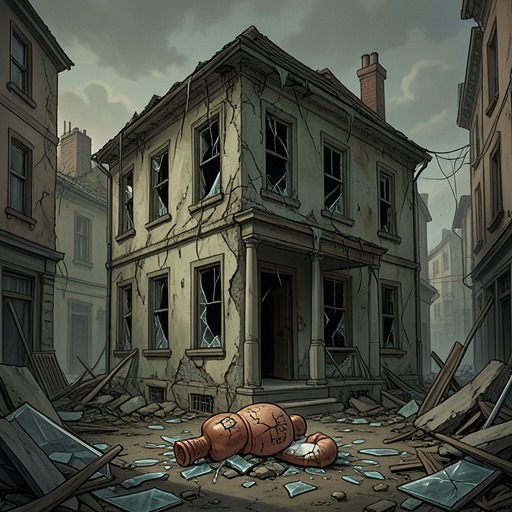
The rescue attempt does not restore safety. The house continues to shed objects, and the children make their way out through the open door. Outside, Ann holds Eve and Josh back when they try to go inside again, while the clatter continues within. After the sounds abate, Ann looks through a doorway cluttered with debris. The roof has collapsed and the interior walls have buckled; the long clock lies on its side with its Roman-numeral face smashed, and shards from the chandelier cover the surfaces. Dust fills the ruined interior. These details show that the danger has grown beyond a hazardous stairway or falling contents: the building itself has failed.
Ruins and Remnants
Ann enters the wreckage and finds Oliver Rose and Barbara Rose beneath the rubble. Their bodies are covered in white dust, their faces fixed in death, and they appear to be embracing, their eyes still locked together. The apparent embrace gives the house’s destruction a final, painful intimacy. The place that Oliver had imagined as a fort for a family now contains the couple’s deaths, with their last pose suggesting connection without undoing the violence and estrangement that brought them there.
Eve Rose and Josh Rose enter the rubble behind Ann, sobbing and searching for their parents. Eve asks why they did this; Ann can only shake her head. The children then move among the debris themselves: Josh is on his knees while Eve shifts rubble with her shoe. In her left hand, Eve holds the Molineaux statue, which remains intact, its black head shining clean despite the destruction. That surviving object stands in sharp contrast to the smashed clock, broken chandelier, buckled walls, and collapsed roof. The house is no longer a refuge or a contested prize; it is wreckage, while a single familiar figure endures within it.